Scalpers have been exploiting the high demand for Department of Motor Vehicles (DMV) appointments in Miami-Dade County by hoarding free slots and reselling them for as much as $250 each.
These individuals or groups use tactics like bots and fake accounts to secure large numbers of appointments through the online booking system, then turn around and sell them to residents desperate to avoid long wait times.
The Miami-Dade County Tax Collector’s Office, led by Dariel Fernandez, uncovered this network and is actively working to stop it. They’ve reported that the practice has been particularly rampant since the county took over driver’s license services from the state, with over 200 suspicious appointments flagged at a new downtown Miami location alone in its first few weeks.
Fernandez has made it clear that his office won’t honor appointments obtained through this kind of abuse and is pushing for a new ordinance to make selling DMV appointments illegal, potentially carrying a $500 fine or up to 60 days in jail. The ordinance has passed its first reading and is set to be finalized soon.
A Dayton, Ohio photographer named Marissa Alcorn stumbled upon an incredible find at a local Goodwill store. Initially reluctant to visit the thrift shop after dinner with her fiancé Arron, Marissa was persuaded to take a quick look. As they were about to leave empty-handed, an employee wheeled out a cart, and Marissa spotted the corner of a frame that caught her eye. Priced at just $2.99, she found the painting itself unappealing but decided to buy it anyway, thinking it might be useful for her photography studio or home, both of which are largely furnished with thrifted items.
What started as a casual purchase turned into a remarkable discovery. After some research and authentication through an auction house in Cincinnati, the painting was revealed to be the work of a noted American impressionist painter. Pre-bidding began at $600, and on auction day, a 30-second bidding war drove the price up to $2,300.
Marissa, who had been nervous yet hopeful it might fetch $1,500, was stunned by the outcome. She described it as a “once in a lifetime thing,” doubting she’d ever find such a treasure again. Recently engaged, Marissa and Arron plan to put the unexpected windfall toward their upcoming wedding.
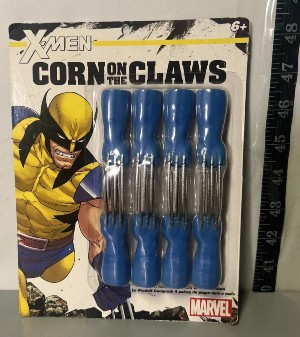
Delve into the world of Marvel with these unique Wolverine “Corn On The Claws” corn cob holders, a must-have for fans and collectors alike.
Crafted with care in Canada, these holders are designed to bring a touch of the comic book hero to your kitchen and dining experience. Perfect for any gathering, these holders are not handmade, ensuring consistency in quality and design.
They are an ideal addition to your collectibles or a playful gift for those who appreciate Marvel’s iconic characters integrated into everyday items.
On March 20th, 1930, a pivotal moment in culinary history unfolded that would eventually give rise to one of the most iconic fast-food chains in the world: Kentucky Fried Chicken, or KFC for short.This date marks the day Harland David Sanders, a man of grit and determination, took a significant step toward building his fried chicken legacy.
Born on September 9th, 1890, in Henryville, Indiana, Harland Sanders was no stranger to hard work. After losing his father at a young age, Sanders took on various jobs throughout his life. He was a farmhand, streetcar conductor, blacksmith’s apprentice and railroad fireman, just to name a few. By 1930, he had settled in Corbin, Kentucky, where he operated a service station along U.S. Route 25, a busy road for travelers. It was here that Sanders began to lay the groundwork for what would become his fried chicken empire.
While March 20th, 1930, is often cited as a key date in KFC lore, it doesn’t mark the official founding of the KFC franchise as we know it today. Instead, it’s the day Sanders is said to have first served his now famous fried chicken to customers at his service station. At the time, Sanders wasn’t running a restaurant in the traditional sense. He began cooking for hungry travelers who stopped by for gas, offering home cooked meals like pan fried chicken, ham, biscuits and vegetables. His food quickly gained a reputation for its quality and flavor, especially his chicken, which he prepared using a blend of spices that would later become the cornerstone of KFC’s “Original Recipe.”
Sanders’ cooking wasn’t an overnight sensation. By 1930, he had perfected a method of pressure frying chicken, which cooked it faster than traditional methods while keeping it juicy and flavorful. This innovation, combined with his secret blend of 11 herbs and spices, set his chicken apart from anything else on the market.
The success of his roadside meals led Sanders to expand his operation. He soon opened a small dining area next to the service station, calling it “Sanders Court & Café.” It wasn’t a franchise yet, but it was the precursor to KFC. The café became a local hit, drawing in travelers and residents alike. In 1935, Kentucky Governor Ruby Laffoon recognized Sanders’ contributions to the state’s cuisine by commissioning him as a Kentucky Colonel. This would be an honorary title that Sanders would later embrace as part of his public persona.
While this historic day in 1930 marks the beginning of Sanders’ fried chicken journey, the KFC franchise as we know it didn’t come into being until much later. In 1952, Sanders struck a deal with Pete Harman, a restaurant owner in Salt Lake City, Utah, to sell his chicken under the name “Kentucky Fried Chicken.” This was the first true franchise, and it launched the brand into national prominence. Sanders sold the company in 1964 for $2 million (about $18 million in today’s dollars), but he remained its public face, donning his signature white suit and black tie until his death in 1980.
So, the next time you bite into a piece of KFC, remember that it all traces back to a dusty service station in Corbin, Kentucky, and a man with a vision, flipping chicken on March 20th, 1930. The day that started the meal and an entire movement.
In the central Dutch city of Utrecht, a unique initiative called the “fish doorbell” has captured the attention of millions worldwide.
An underwater camera at the Weerdsluis river lock streams live footage to a website, allowing viewers to spot fish waiting to pass through during their spring migration to shallow spawning grounds. When someone sees a fish, they can press a virtual button (nicknamed the “fish doorbell”) sending a screenshot to organizers. Once enough fish are spotted, a water worker is alerted to open the lock, helping species like bream, pike and bass continue their journey.
Now in its fifth year as of March 2025, this quirky blend of slow TV and ecological activism has become a global hit. The stream often shows just murky green water with occasional bubbles, but as spring progresses and waters warm, more fish appear, delighting viewers.
Beyond entertainment, it’s a lifeline for these native freshwater fish which can get stuck behind the lock and become easy prey for predators when boat traffic is low. The project, dreamed up by ecologist Mark van Heukelum, has turned into an unexpected sensation, proving that a simple, feel-good idea can hook millions!
A new survey has dropped a quietly alarming statistic: 38 percent of Americans didn’t read a single book in the past year. Not a novel, not a memoir, not even a self help guide promising to unlock the secrets of productivity. In a world overflowing with information (where books are more accessible than ever thanks to e-readers, audiobooks and libraries) this number feels like a cultural gut punch. So, what’s going on?
Let’s start with the obvious: life is busy. Between work, family, and the endless scroll of social media, finding time to sit down with a book can feel like a luxury many can’t afford. The survey doesn’t specify why people aren’t reading, but it’s easy to imagine the culprits. Netflix binges, TikTok rabbit holes and the constant ping of notifications are stiff competition for a 300 page novel. Attention spans are shrinking. Studies have suggested the average person’s focus is down to about eight seconds. Keep in mind, this is shorter than that of a goldfish. Books demand more than that.
Then there’s the question of access and habit. While books are technically easier to get than ever, not everyone grew up with a bookshelf at home or a library down the street. Reading isn’t just about availability; it’s about culture. If you didn’t see your parents crack open a paperback or if school didn’t hook you on a story that stuck, the habit might never take root. For some, books might even feel intimidating. They can be gatekeepers of a world we weren’t invited into.
On the flip side, maybe this isn’t a crisis. People are still consuming stories and ideas. Podcasts, long-form articles and even video essays are filling the gap for some. The survey doesn’t say Americans aren’t learning or engaging; it just says they’re not reading books. Perhaps the medium matters less than the message.
Still, there’s something haunting about the stat. Books have been humanity’s companions for centuries, carrying our history, dreams and warnings. If 38 percent of us are tuning out that conversation entirely, it’s worth asking: What are we missing? And what happens if that number keeps creeping up?
The blobfish, often dubbed the “world’s ugliest animal,” has been named New Zealand’s Fish of the Year for 2025.
This deep sea creature, known scientifically as Psychrolutes marcidus, won the annual competition organized by the Mountains to Sea Conservation Trust, which aims to raise awareness about New Zealand’s marine and freshwater species.
The blobfish secured nearly 1,300 out of over 5,500 votes, beating out the orange roughy by about 300 votes. Its victory marks a turnaround from its 2013 reputation as the mascot of the Ugly Animal Preservation Society, highlighting its unique gelatinous form (adapted to thrive in the high pressure depths off New Zealand and Australia) and sparking discussions about deep sea conservation.
Carl Erik Rinsch, the director of the 2013 film 47 Ronin, was indicted on March 18th, 2025, for allegedly defrauding Netflix of $11 million. The funds were intended for a sci-fi series originally titled White Horse (later renamed Conquest), which he never completed.
Federal prosecutors from the Southern District of New York have charged him with wire fraud, money laundering and multiple counts of engaging in monetary transactions with property derived from illegal activity.
The allegations state that Rinsch misused the $11 million (part of a larger $55 million investment from Netflix) on personal expenses and investments, including risky securities trades, cryptocurrency, and luxury purchases like Rolls-Royces, a Ferrari, and high-end furniture.
If convicted, he could face up to 90 years in prison if the sentences are served consecutively. Rinsch was arrested in West Hollywood and is set to face trial in New York.
The year is 1868 and the notorious Jesse James Gang pulled off a daring heist, robbing a bank in Russellville, Kentucky, of $14,000. This was a hefty sum for the time. Led by the infamous outlaw Jesse James, the gang stormed the Southern Bank, making off with cash and leaving a trail of chaos. This robbery cemented their reputation as one of the Wild West’s most feared crews.
In 1897, hoops history was made as Yale and Penn faced off in the first intercollegiate basketball game with five players per team. Yale dominated, winning 32-10. The game’s evolved a bit since then!
In 1939, President Franklin D. Roosevelt nominated William O. Douglas to the U.S. Supreme Court. Douglas, a prominent legal scholar and SEC chairman, would go on to serve as an associate justice for over 36 years, leaving a lasting impact on American jurisprudence with his staunch defense of civil liberties and environmental protections.
In 1965, President Lyndon B. Johnson took a stand for justice, ordering 4,000 troops to safeguard the Selma-Montgomery civil rights marchers. This pivotal moment showcased the federal government’s commitment to protecting those fighting for equality as brave activists marched against racial injustice in Alabama.
In 1982, U.S. scientists returned from Antarctica with a groundbreaking discovery: the first land mammal fossils ever found on the continent. Led by Dr. William J. Zinsmeister of Ohio State University, the team unearthed bones of a small, rat-sized marsupial on Seymour Island. This find provided crucial evidence supporting the theory that marsupials migrated from South America to Australia via Antarctica millions of years ago when the continents were still connected. A historic moment in paleontology, it reshaped our understanding of ancient life and continental drift.
In 1999, history was made as Bertrand Piccard and Brian Jones became the first men to circumnavigate the Earth in a hot air balloon. Their incredible non-stop journey began on March 3rd, spanning an impressive 26,500 miles before touching down, proving the impossible was possible with courage and a bit of hot air!


 The Social Pie Network!